Invoice best practices: what to put on every invoice so you get paid on time
An invoice gets paid on time when the person who approves it can say yes without asking you a question. That means it carries a unique number, an exact due date (not just 'Net 30'), the customer's purchase-order number if they use one, line items that match what they agreed to buy, and a one-click way to pay. It is sent to the right person the day the work is delivered, and it is followed by a reminder schedule that runs whether or not you remember. Most late payments are not refusals; they are invoices stuck in someone's approval queue for want of one of those details.
What must every invoice include?
At a minimum:
- Your legal business name, address and contact email, matching the name on your W-9 or contract. A mismatch can send you to the back of a vendor-onboarding queue.
- The customer's legal name and billing contact, which is often accounts payable rather than the person who hired you.
- A unique, sequential invoice number. Never reuse or skip numbers; duplicates confuse both your books and theirs.
- Issue date and an explicit due date. Write 'Due December 3, 2026', not just 'Net 30'. People act on dates, and it removes any argument about when the clock started.
- The customer's PO number or project reference. Large companies often cannot pay an invoice without one.
- Itemized lines with quantity, rate and description in the customer's language: 'Website redesign, milestone 2 of 3 (design approval)', not 'Services'.
- Taxes shown separately, where you charge sales tax.
- Payment instructions and a pay link: ACH details, card link and any other accepted method.
- Your terms: late-fee policy (if your contract includes one) and whom to contact with questions.
How should you set payment terms?
Pick terms per customer type rather than one default for everyone:
- Small clients and individuals: due on receipt or net 15.
- Mid-sized businesses: net 30 is normal and rarely questioned.
- Enterprises: they will often impose net 45 to net 60. Negotiate a deposit or milestone billing to compensate, rather than fighting the terms.
- Projects longer than a month: never bill everything at the end. A deposit at kickoff and milestones after that keep your cash in step with your costs.
- Subscriptions: bill in advance for the period, monthly or annually, and turn on autopay where you can.
Late fees are only enforceable if they're in the agreement your customer signed, and some states limit how much you can charge. Put them in the contract first, then on the invoice. In practice a polite, early reminder does more than a fee.
Which payment methods should you offer, and what do they cost?
Offer at least two: bank transfer (ACH) and card. The fee difference is large on business-sized invoices. Using Stripe's published US pricing as an example, domestic cards cost 2.9% + 30¢ per transaction and ACH Direct Debit costs 0.8%, capped at $5.
On a hypothetical $8,500 invoice:
- Card: 2.9% × $8,500 + $0.30 = $246.80
- ACH Direct Debit: 0.8% × $8,500 = $68, capped at $5.00
If you send 20 invoices of that size a month and every customer paid by card, you'd spend about $4,900 a month on fees, versus $100 if they all paid by ACH. Offering a card link is still worth it for small invoices and for customers who would otherwise pay late, but make ACH the default and the easiest option on the page.
When and how should you send an invoice?
- Send it the day the work is delivered, or on a fixed day for recurring work. Every day you wait is a day added to when you'll be paid.
- Send to accounts payable and copy your contact. The contact confirms the work; AP pays it.
- Attach a PDF and include a pay link. Some AP teams need the PDF for their system; everyone else just wants the link.
- Use a consistent subject line: 'Invoice 1047 from Acme Design, due Dec 3, 2026, $8,500.00'. It makes your invoice easy to find in a crowded inbox.
What reminder schedule actually works?
A reminder schedule that runs automatically beats one that depends on you remembering. A reasonable default for net-30 business customers:
- 3 days before due: a friendly heads-up with the pay link.
- On the due date: 'due today', with the pay link.
- 7 days late: a short note asking whether anything is blocking payment. Often there is: a missing PO, a wrong contact, a question about one line.
- 21 days late: a personal email from the account owner, not the system.
- 45 days late: a phone call, and a pause on new work until the account is current.
Keep the tone neutral. The customer who forgot and the customer who's struggling both pay faster when the next step is easy and the conversation is friendly.
How should invoices show up in your books?
On an accrual basis, an invoice creates a receivable and revenue when it's issued; the payment then clears the receivable. Two practical points:
- Match payments to invoices exactly. A lump-sum ACH covering three invoices needs to be applied to all three, or your aging report will show paid invoices as overdue and you'll chase customers who already paid.
- Record processor fees as an expense. If Stripe pays out $8,253.20 on an $8,500 invoice, the invoice is paid in full and the $246.80 difference is a fee, not a short payment.
Which numbers tell you whether invoicing is working?
Watch three each month:
- Days sales outstanding (DSO): how long customers take to pay, on average.
- Percentage of invoices paid by the due date.
- The receivables aging: how much is current, 1–30, 31–60 and over 60 days past due.
If DSO is creeping up, look at the oldest invoices first. They usually share a cause, such as a missing PO, a customer whose AP contact changed, or a line item that confused someone.
How do you automate all of this?
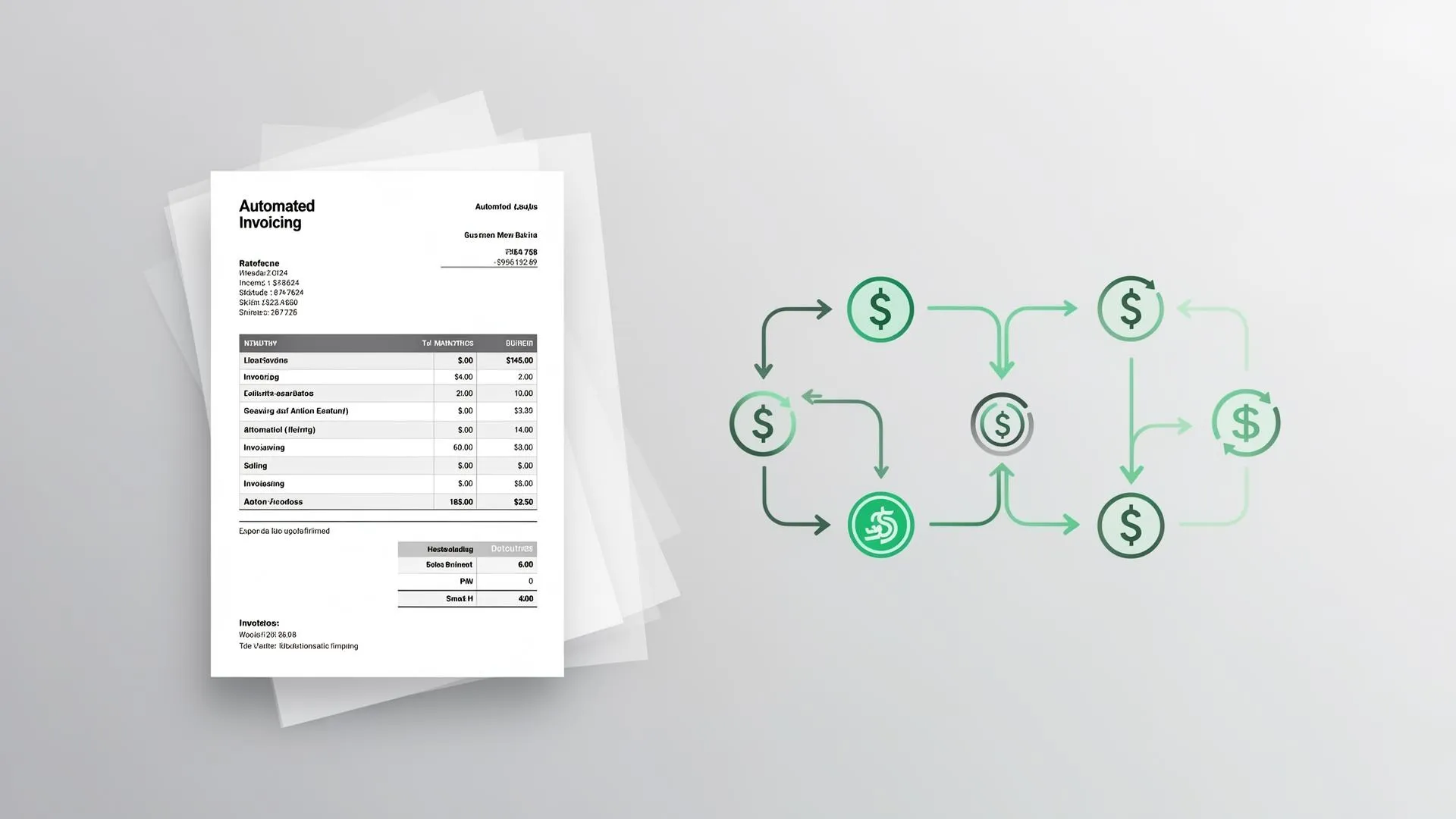
Invoicing software should do the repetitive parts: numbering, due dates, recurring invoices, pay links, reminders, and matching payments back to the invoice. ClearBooks' invoicing handles recurring invoices, ACH collection through Stripe and automatic late-payment reminders, and our guide to reducing late payments with automation goes deeper on reminders and autopay. For what late invoices do to your bank balance, see our cash flow guide.
Sources
- Stripe, Pricing (US domestic card and ACH Direct Debit rates, used as an illustrative example)